
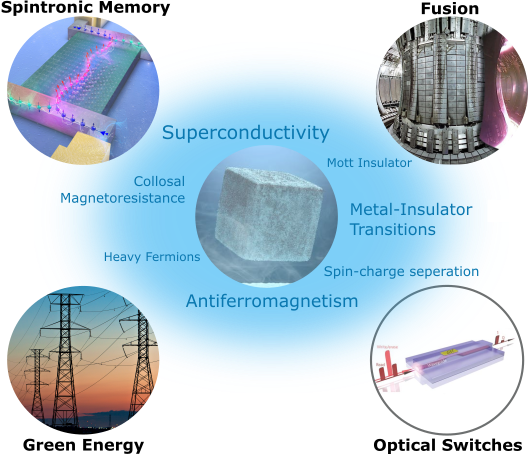
Emergent effects inside quantum materials and their potential applications.
Quantum materials are characterized by their complex interplay between different degrees of freedom, which lead to fantastic emergent properties like superconductivity that make them attractive for applications. In equilibrium they are very difficult to understand because disturbing one degree of freedom (like the electrons) causes a reaction in all the others (phonons, magnons, orbitals, topologies, etc.), making it nearly impossible to understand which interactions are key for the emergent states. Using ultrafast spectroscopy, however, we can separate out these interactions in time and learn which are key for emergent phases. This is especially true when driving materials through ultrafast phase transitions, where materials undergo not simply small perturbations but instead changes in their internal symmetries, giving massive changes in their properties. Even better, we can, through selective excitation, actually engineer new states of matter than never exist in equilibrium.
In the USQM group we have pioneered measuring ultrafast phase transitions at their smallest length and time scales, from the action within single unit cells near the attosecond time scale to nanometer scale changes over femtoseconds.
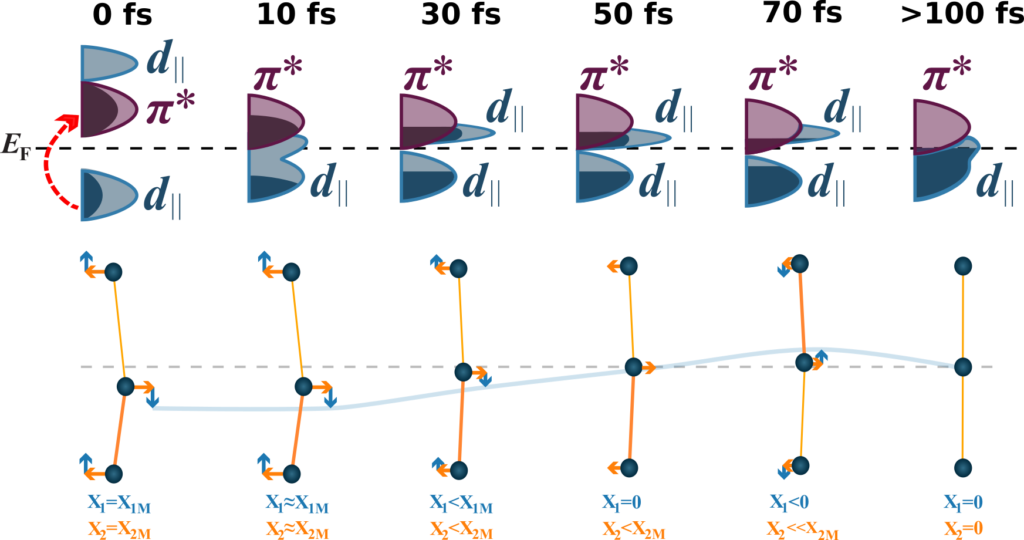
Schematic representation of the full structural and electronic evolution of VO2 determined using few-femtosecond spectroscopy from Brahms et al., Nature Communications (2025).